ATCSTW — Upstream Data Analytics
Follow any dollar.
Prove every claim.
For newsrooms, nonprofits, campaigns, compliance teams, and builders who need to follow money through public records, ATCSTW resolves fragmented government data into one connected, source-stamped graph — and serves it by API, pack, and suite at published prices.
Get a free API key See published pricing
FREE TIER: 1,000 CALLS/MO · THE WHOLE CATALOG AT SHALLOW DEPTH · NO CARD
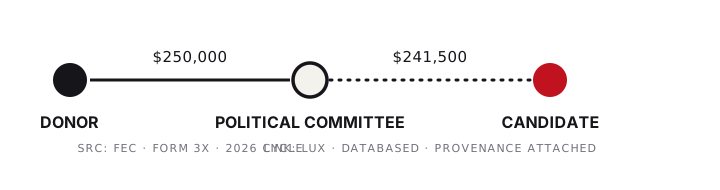
THE SIGNATURE VIEW: EVERY EDGE CARRIES ITS FIGURE AND ITS SOURCE
One graph, not forty databases.
Public records about money and power are published in fragments — a filing here, a registry there, a disclosure in a format designed to be filed, not read. The entities are the same. The names, addresses, and identifiers are not.
ATCSTW collects those fragments, resolves them to the companies, committees, people-in-office, and organizations they actually describe, and connects what the records prove is connected. The connection engine is Lux. Every connection Lux makes is databased with the records that support it — a connection that cannot be proven from the records is not shown.
Correlation is labeled correlation. Measured figures and modeled figures are never blended into one number. Coverage gaps are published on the Freshness page, where the data is sold — not after you ask.
Three ways in. One graph underneath.
ATCSTW Data API
The graph, served programmatically. REST endpoints across politics, corporate records, health, patents, science, and donor aggregates — every response carries the source stamp of the records behind it. Start free: the Free tier reaches the whole catalog at shallow depth. Pay for depth, volume, and bulk — not for breadth.
ATCSTW Nonprofit Suite
The graph, as a working tool for mission organizations. Prospect research on donor aggregates, a grants pipeline, campaign and peer-organization profiles, communications, and impact reporting — built on the same resolved data the API serves, at a price a nonprofit can approve without a procurement process.
Lux — the connection engine
Lux is the engine that resolves entities and databases the connections between them. When an ATCSTW product shows you that a company, a committee, and a contract are the same story, that connection is Lux's — stamped with the records that prove it. Look for Powered by Lux on every connection, chain, and dossier we serve.
What the graph covers.
U.S. public records on money and power: federal campaign finance (aggregates — see the note below), lobbying disclosures, federal contracts and grants, corporate registries and ownership, OSHA / EPA / FDA and wage-and-hour enforcement, health and drug pricing, patent records, and IRS nonprofit filings. Coverage is stated per dataset, with its source, its cadence, and its last successful pull, on the Freshness page. Where a dataset is partial, the page says so in the same size type as the claim.
A note on campaign-finance data, stated plainly.
Federal law (§30111(a)(4)) restricts the use of FEC-reported contributor data. ATCSTW serves campaign-finance data in aggregate only. We do not serve individual contributor names or addresses, at any tier, at any price.
The same data, in public, every day.
ATCSTW is the data layer beneath the MTCSTW media network. The figures in its published stories, its creator network's content, and its public data products resolve to the same graph the API serves — the same records, the same source stamps. Most data vendors sell you data nobody sees used. Ours is in action downstream, where anyone can check its work.
How we work, in public.
Corrections
A public, dated, permanent log. If we got something wrong, the correction is published, not buried: corrections@atcstw.com.